An overheating engine can become an expensive engine repair quickly, especially in Tucson heat. Shut the vehicle down if the temperature climbs into the danger zone, steam appears, or coolant is pouring out. Do not remove a hot radiator cap.
Vibrance Automotive diagnoses the source of overheating or coolant loss before replacing parts.
Cooling-system problems we handle
- Temperature gauge rising above normal
- Coolant leaks or repeated low-coolant warnings
- Cooling fans that do not operate correctly
- Radiator, thermostat, hose, reservoir, or cap problems
- Water-pump leaks, noise, or circulation concerns
- Weak cabin heat or changing temperature at idle
- Contaminated coolant or overdue service
How we find the cause
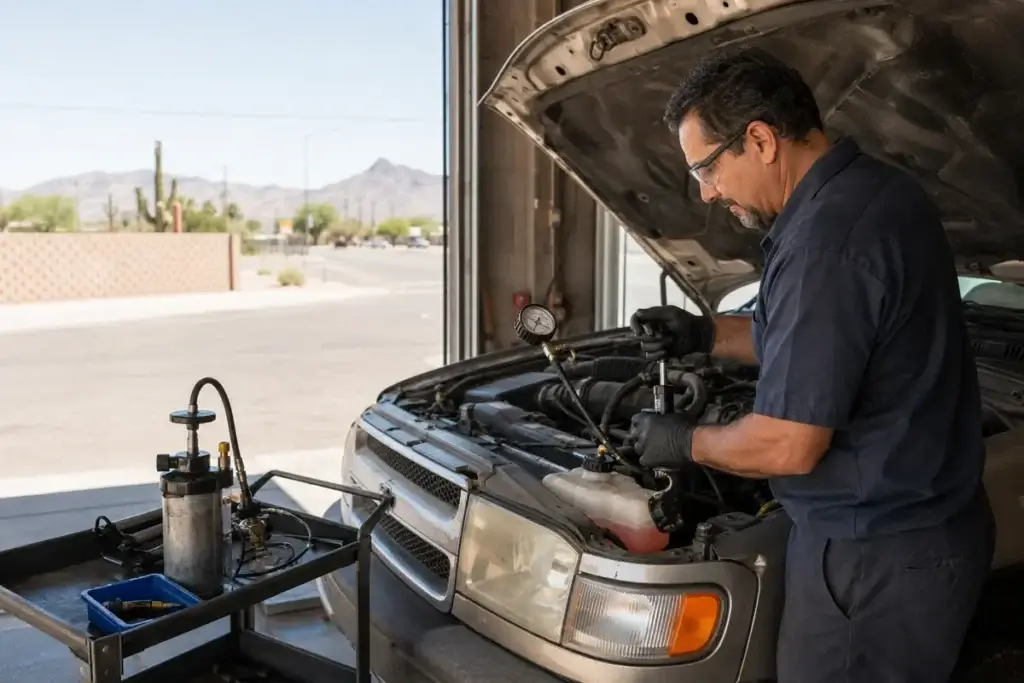
Testing may include a visual inspection, pressure test, cap test, fan-command check, thermostat operation, temperature comparison, coolant condition, combustion-gas testing, and inspection for leaks that appear only when hot. We also look for the reason a component failed, such as a damaged connector, restricted airflow, or neglected coolant.
Overheating does not always begin with the radiator. The cause can be a leak, trapped air, a faulty fan, thermostat, pump, restriction, engine problem, or an incorrect previous repair.
Radiator repair and coolant leaks
Coolant can escape from a radiator tank, hose connection, reservoir, heater hose, water pump, thermostat housing, or a small plastic fitting. Some leaks leave a clear puddle. Others evaporate on a hot engine or appear only when the system is under pressure.
Replacing a radiator will not fix a leaking water pump or a fan that never turns on. We pressure-test and inspect the system so the estimate is tied to the failed part.
Fans, thermostats, and water pumps
A vehicle that overheats in traffic but cools down on the highway may have an airflow or fan problem. A vehicle that overheats under load may point in another direction. Thermostats can stick, electric fans can lose power or control, and water pumps can leak or lose circulation.
The pattern helps guide the tests, but the symptom by itself is not proof. We verify operation before recommending the component.
Repair and prevention
After testing, we explain what failed, what damage has or has not been found, and what should be repaired first. Related maintenance is separated from the immediate repair so you can make a clear decision.
Use the coolant specification required for the vehicle. Mixing incompatible coolant or adding stop-leak can create restrictions and make later repairs harder. If the level is low, adding coolant may help get the vehicle out of immediate danger, but the leak still needs to be found.
Related services include belts and hoses, fluid services, timing and water-pump service, and engine repair.
Request cooling-system diagnosis or call before driving an overheating vehicle.