
When the fan blows but the air is not cold
You start the car on a Tucson afternoon, turn the AC on, and hear the blower running. The fan is doing its job. But the air coming through the vents is not cold. The AC is not cooling the cabin and the drive home is uncomfortable.
This is one of the most common complaints we hear. The blower works, the controls respond, but the air temperature tells a different story. The answer is not always as simple as adding refrigerant.
The “just needs charged” assumption
When the air blows warm, most people reach for the same conclusion: “It just needs charged.” Adding refrigerant feels like the obvious fix. But modern automotive AC systems do not consume refrigerant the way an engine consumes fuel. The refrigerant circulates in a sealed loop and does not get used up. If the level is low, it escaped.
Adding more without finding and sealing the escape point means the new refrigerant will escape too. The customer pays for a recharge that does not last. Money spent on refrigerant that leaks back out did nothing to solve the problem.
Low refrigerant means there is a leak somewhere
An AC system that cannot produce cold air because the refrigerant charge is low has a leak. The leak might be a pinhole, a failing seal, a compressor shaft seal that weeps, a condenser damaged by road debris, or an evaporator that corroded. Refrigerant that is no longer inside got out through a breach.
Not every warm-air complaint is a leak. The system could have a compressor clutch not engaging, a blend door stuck in the heat position, a blocked expansion valve, an electrical fault, or a clogged cabin air filter. The free initial check helps separate these possibilities and prioritize the work. Paid diagnosis determines the actual direction.
When further diagnosis confirms the refrigerant charge is low, the direction is clear. Find the leak.

The free initial AC check and what it covers
Vibrance provides an initial AC check at no charge. It confirms whether the vehicle has a genuine AC cooling problem and gives the customer enough information to decide on next steps. It is not a full diagnostic and does not include leak detection.
The free check is designed to establish whether there is a real AC problem and help prioritize customers who need repair. It is the starting point. Once the check confirms a cooling issue, paid diagnostic work picks up where the free check leaves off.
Vibrance explains the recommended next diagnostic step before the customer authorizes paid work.
Paid leak detection: the work that finds the source
Detailed leak detection is paid diagnostic work. It goes deeper than the initial check and uses methods chosen for the specific vehicle and symptoms.
Depending on the situation, we may inject fluorescent dye into the system and use a UV light to trace where refrigerant escapes. On other vehicles, we remove suspect lines, pressurize them, and submerge them in water to watch for bubbles. Neither method is universal. The right approach depends on the vehicle, pressure readings, and what inspection reveals.
Leak detection is diagnostic labor requiring tools, time, and skill. That is why it is not free.
If the customer authorizes the repair based on what leak detection finds, Vibrance usually deducts the leak-detection charge from the repair cost. The exact handling depends on the work involved and will be confirmed before any work begins. No one should authorize leak detection expecting an automatic credit.
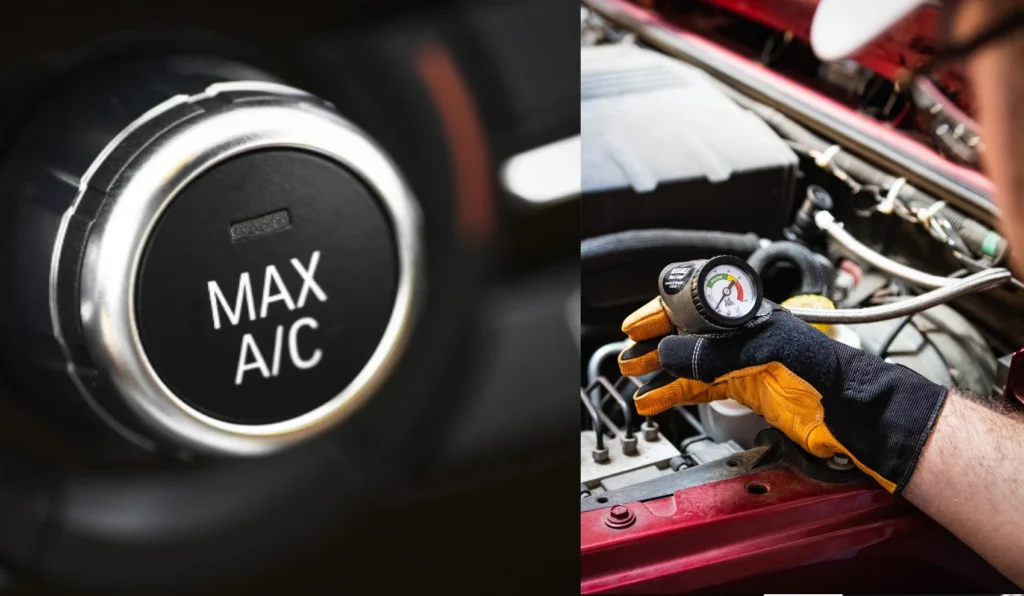
Why finding the source matters more than a fast recharge
The principle that guides our AC work is simple: spend time finding the source so the customer does not waste money on repeated refrigerant charges or unnecessary replacement parts.
A recharge without leak detection is a short-term fix. The customer leaves with cold air and returns with warm air. Over a Tucson summer, the cost of repeated recharges adds up, and the problem never gets solved.
Replacing parts on a hunch is equally wasteful. A compressor replaced because “it is probably the compressor” when the actual fault is a leaking O-ring leaves the customer paying for a part and labor they did not need while the leak remains.
Leak detection identifies the actual failure so the repair targets the right component. The goal is to identify what failed and fix only that, not to sell parts.
AC work in the context of Tucson heat
Tucson summers place heavy demand on vehicle AC systems. High ambient temperatures force the condenser to reject more heat, pressures run higher, and the compressor cycles under greater load. This is not unique to Tucson, but it is a reality here.
Higher ambient temperatures increase the demand on the AC system and can make an existing problem more noticeable. A system that was marginal may fail to keep up on a hot day when it seemed fine during cooler weather. We recommend addressing AC symptoms when they appear rather than waiting.
There is no off-season for cabin cooling in Tucson.
Bring your AC problem to Vibrance
If your AC is blowing warm air, start with the free initial check. It costs nothing, confirms whether there is a cooling problem, and gives you a clear answer about next steps.
Vibrance is a full-service shop. AC diagnosis often sits alongside other work: a vehicle that comes in for a cooling complaint may also need starting and charging system testing, routine maintenance, or suspension work. We handle the full scope, not just the symptom that brought you in.
Call us at 520-261-3533 or schedule an appointment online to get the free AC check started. We will tell you what we find and what it will take to get your AC working again.