
If an adaptive-light warning appears after windshield, collision, suspension, alignment, or headlamp work, tell the technician when it started. That timing can be the fastest clue in the diagnosis. The fault may involve calibration or sensor position rather than a failed headlamp assembly.
Several systems have to agree
An adaptive headlight may use steering angle, vehicle speed, yaw, ride height, camera information, and commands from a lighting or body-control module. Motors inside the lamp move or level the optics. Network communication carries information between components that are located far apart on the vehicle.
A warning naming the headlamp does not prove that the complete assembly is bad. A damaged ride-height sensor arm, lost calibration, poor connection, low system voltage, communication fault, or camera issue can prevent an otherwise working lamp from responding correctly.
Leveling and curve lighting solve different problems
Automatic leveling adjusts vertical aim as passengers, cargo, acceleration, braking, or suspension position change the way the vehicle sits. Curve-adaptive lighting turns a projector or adds corner illumination based on steering and speed. A system may have one feature without the other.
Watch what happens at startup on a level surface. Some lamps perform a short movement check. One side that fails to move, returns to a different position, or points noticeably high or low gives the shop useful information. Do not attempt to force a lamp motor by hand.
Matrix lighting controls pieces of the beam
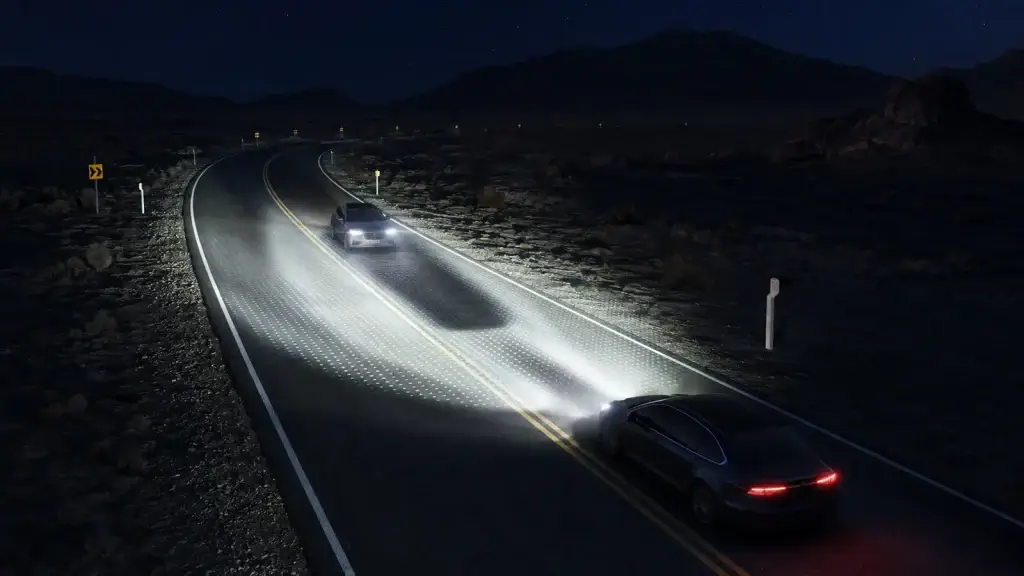
A matrix high beam divides its output into separately controlled segments. A forward camera identifies traffic and other features in the scene. The system can reduce selected portions of the high beam while leaving more light on open parts of the road.
The result depends on correct camera information, headlamp aim, module communication, clean lenses, and software designed for that vehicle and market. A camera that is obstructed or no longer calibrated can change how high-beam assistance behaves even when both lamps illuminate.
Calibration comes after the basics
Mechanical aim and physical condition are checked before electronic calibration. A cracked mount, incorrect ride height, damaged sensor, low tire, or improperly installed lamp can make calibration fail or produce a poor result.
Windshield replacement can affect the forward camera. Suspension changes can alter base headlight height or the position reported by a level sensor. Collision repair and lamp replacement can move the optics. Depending on the manufacturer, the repair procedure may call for a static target setup, a dynamic road procedure, or both.
A sensible diagnostic order
- Confirm the warning and the actual lighting behavior.
- Inspect housings, mounts, connectors, sensor arms, wiring, lenses, and moisture.
- Scan the relevant modules and review live sensor information.
- Test power, ground, charging voltage, and network communication where indicated.
- Verify base aim and ride height before calibration.
- Perform the manufacturer-required calibration and confirm operation afterward.
These assemblies are expensive, which makes the order of testing important. Vibrance Automotive can inspect the electrical, mechanical, and calibration side of an adaptive-lighting complaint before a complete lamp is ordered.