
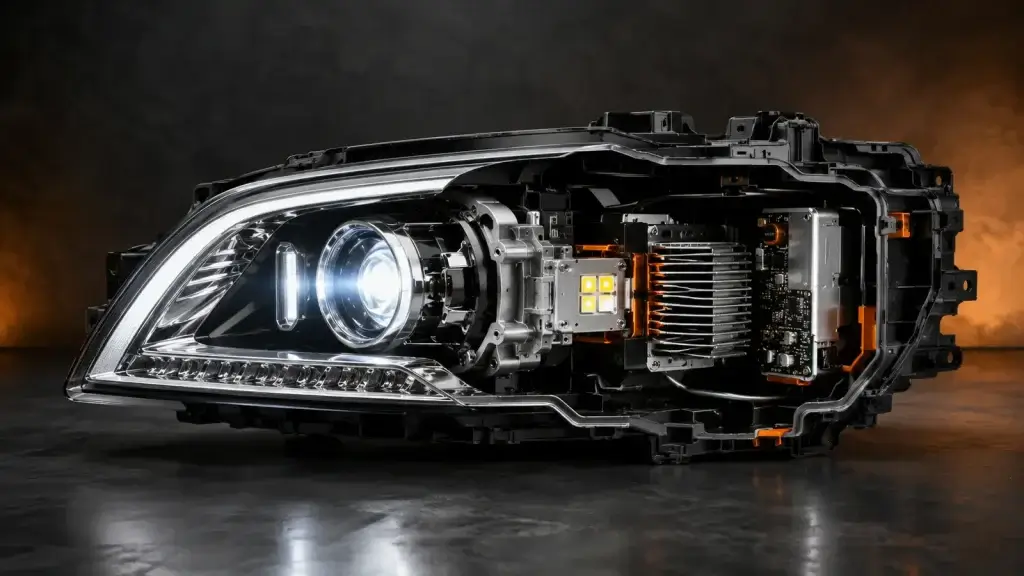
An LED headlight is not simply a bright diode behind a clear lens. Power has to be controlled, heat has to leave the emitter, optics have to place the light on the road, and the assembly may need to communicate with several vehicle modules. A failure anywhere in that chain can change the beam or turn the lamp off.
The light starts on a circuit board
One or more semiconductor emitters are mounted to a metal-core board. Each emitter produces light from a very small surface, so its position relative to the reflector or projector matters. Moving that source even slightly can scatter the pattern, create dark areas, or place glare above the cutoff.
This is why an aftermarket LED placed into a housing designed for a halogen filament can look bright near the car while putting less useful light down the road. Advertised lumens do not describe beam control.
The optics decide where the light goes
A projector may use a reflector bowl, cutoff shield, and lens. A reflector headlight uses shaped surfaces around the source. Both are engineered around the original light position. Clouded outer lenses, damaged internal surfaces, loose mounting points, incorrect replacements, and poor aim can reduce visibility even when the lamp still illuminates.
The driver keeps the LED alive
LEDs need regulated current. The driver converts vehicle voltage into what the emitters require and may provide protection against heat, reverse polarity, and abnormal voltage. Newer vehicles can add lamp modules, body-control commands, pulse-width modulation, CAN communication, and failure monitoring.
Flicker or intermittent operation can therefore originate in a connector, ground, charging problem, control signal, software issue, driver, or emitter. Replacing the visible lamp without testing the circuit may leave the cause untouched.
Heat leaves through the back of the assembly
The emitter is efficient, but its remaining heat is concentrated in a small area. A thermal interface moves that heat into an aluminum sink, fins, a heat pipe, or a fan. Tucson underhood temperature and fine dust make the cooling path important. A blocked heat sink, failed fan, poor thermal connection, or overdriven emitter can cause dimming, color change, shutdown, and early failure.
The housing has to breathe without leaking
Seals and rear caps keep direct water and dust away from the optics and electronics. Filtered vents let pressure and humidity equalize as the lamp heats and cools. A light haze that clears may be normal. Droplets, standing water, corrosion, or repeated module failure call for inspection of the housing, caps, vents, and seams.
What the shop checks
Diagnosis begins with the complaint. Is the lamp dark, flickering, dim, wet inside, aimed incorrectly, or producing a warning message? From there, testing may include battery and charging voltage, power and ground under load, voltage drop, connector condition, fault codes, module communication, driver output, housing damage, cooling, beam pattern, and aim.
A simple observation helps before the appointment. Park on level ground facing a wall and compare the two patterns. Note whether the fault changes after a few minutes, over bumps, or with other electrical loads. Do not adjust the aim solely to hide an uneven pattern.
If a headlight is repeating failures or no longer provides a controlled beam, Vibrance Automotive can inspect the electrical supply, modules, housing, cooling, mounting, and aim before recommending parts.