
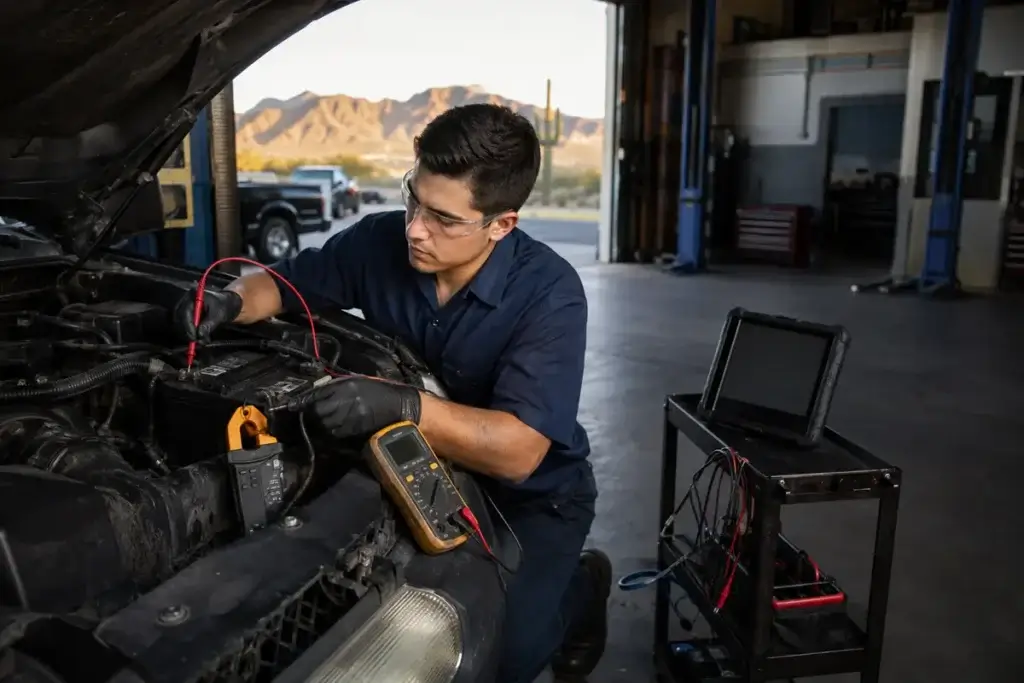
A no-start problem does not automatically mean the battery is bad. A slow crank, intermittent start, repeated dead battery, charging warning light, or electrical problem can come from the battery, starter, alternator, wiring, grounds, switches, modules, or a parasitic draw.
Vibrance Automotive tests the starting and charging system before recommending parts. That matters when several components can produce the same symptom.
Electrical problems we diagnose
- No crank, slow crank, or clicking when the key is turned
- A vehicle that starts sometimes and fails at other times
- A battery that repeatedly goes dead
- Battery or charging warning lights
- Lights, accessories, windows, locks, or modules behaving inconsistently
- Blown fuses, damaged wiring, poor grounds, or suspected parasitic draw
How electrical diagnosis works
We begin with the symptoms and failure pattern. Testing may include battery condition, voltage drop, charging output, starter current, circuit integrity, grounds, fuse protection, and current draw while the vehicle is off. Intermittent problems may require reproducing the condition or testing during the failure.
A scan tool is useful when a module has stored a fault, but electrical diagnosis also requires a meter, a wiring diagram, and checks made at the right point in the circuit. A low-voltage code does not prove that the component named in the code has failed.
Battery, starter, or alternator?
A weak battery can be the result of a charging fault instead of the cause. A starter may click because voltage cannot reach it through a damaged cable or ground. An alternator can pass a quick output check and still fail under load or at a particular temperature. We test the related pieces together before separating the repair.
If the battery dies after the vehicle sits, we can test for a parasitic draw. Finding the circuit is only the first step. The cause might be a light, module, accessory, damaged wire, or equipment that was added later.
Wiring and intermittent faults
Tucson heat, vibration, fluid leaks, rodents, corrosion, and previous accessory work can all damage wiring. We look for rubbed-through insulation, loose terminals, overheated connectors, poor splices, and voltage loss across connections. Intermittent problems take time because the circuit may behave normally while it is being tested.
You receive the findings and a vehicle-specific estimate before repairs begin. If the vehicle is stranded, call before arranging a tow so we can discuss safe drop-off and availability.
Related systems
A no-start condition can also involve fuel, ignition, an immobilizer, or engine-management systems. We separate the electrical fault from other possibilities before choosing a repair path.
Related services include battery and charging system repair, check engine diagnostics, engine repair, and European auto electrical diagnosis.