
A failed engine mount can make a vehicle feel much worse than the engine actually runs. The engine may vibrate at idle, thump when shifting, or move enough to stress hoses, wiring, exhaust parts, and nearby components. Those symptoms still need diagnosis because misfires, transmission problems, exhaust contact, and worn suspension parts can feel similar.
Vibrance Automotive provides engine mount inspection and replacement in Tucson. We check the vehicle under the conditions that produce the complaint and identify which mount or related component is responsible.
Schedule an engine-mount inspection or call (520) 261-3533.
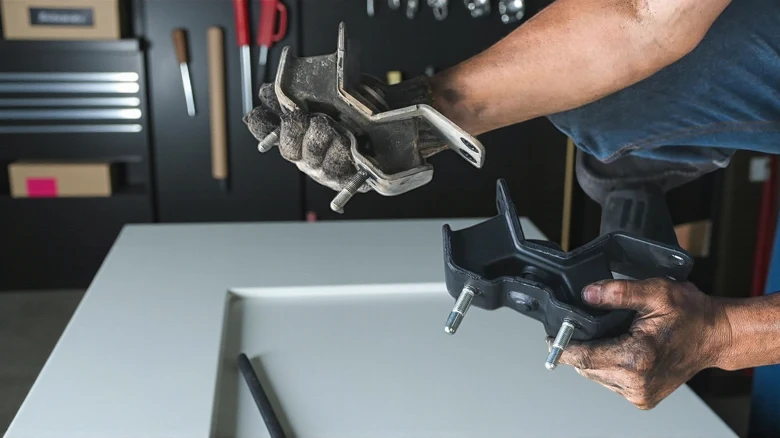
What Engine Mounts Do
Engine and transmission mounts secure the powertrain while isolating normal vibration from the body. Most vehicles use several mounts, and they do not all carry the same load. Some are simple rubber-and-metal assemblies. Others are hydraulic, electronically controlled, or designed to change stiffness under different operating conditions.
A mount has to allow limited movement without letting the engine strike surrounding parts or transfer excessive vibration into the cabin.
Symptoms of a Worn or Broken Mount
- Excessive vibration at idle, especially in gear
- A clunk or thump when shifting between drive and reverse
- Movement or impact during acceleration and deceleration
- New vibration after another repair or collision
- Visible cracking, separation, collapse, or fluid leakage from a hydraulic mount
- Exhaust or other components contacting the body
- The engine sitting lower or differently than expected
The pattern matters. A vibration that changes when the AC compressor engages may involve engine load, idle control, a misfire, or a marginal mount. A clunk over bumps may come from suspension rather than the powertrain.
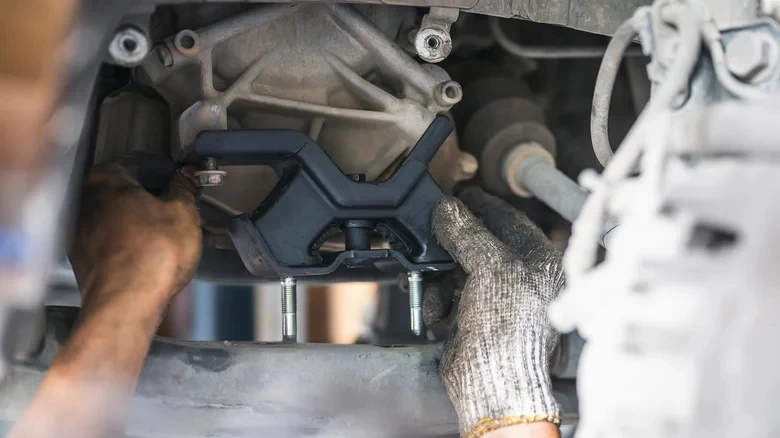
How We Diagnose Engine Mount Problems
We inspect the mounts for separation, cracking, collapse, leakage, damaged brackets, and abnormal movement. The engine may be observed while load is applied in a controlled manner, following a procedure appropriate for the vehicle. We also check for contact marks and related damage.
If the engine itself is running rough, that has to be separated from mount condition. A new mount cannot make a misfiring engine run smoothly; it may only change how much vibration reaches the cabin.
Why One Failed Mount Can Affect Others
When one mount collapses or separates, the remaining mounts may carry loads they were not designed to handle. Additional movement can pull on wiring, hoses, intake ducts, axles, and exhaust joints. That does not mean every mount automatically needs replacement, but the complete mounting system should be inspected.
We explain whether the repair involves one confirmed mount, a pair or set justified by condition and access, or another component entirely.
What Replacement Involves
The engine or transmission must be supported safely while the failed mount is removed. Access varies widely. Some mounts are visible and relatively direct; others sit below intake components, brackets, accessories, the battery tray, or parts of the subframe.
Fasteners and brackets are inspected, the replacement is positioned without forcing the powertrain out of alignment, and required torque procedures are followed. After assembly, movement, clearance, and vibration are rechecked.
Does Tucson Heat Cause Mount Failure?
Heat and age can harden rubber and contribute to deterioration, while fluid leaks may soften or swell some materials. Hydraulic mounts can also leak as they age. Tucson conditions may be one factor, but they do not prove a mount has failed. Physical inspection and symptom reproduction are more useful than a climate-based replacement recommendation.
Related Problems
Engine-mount symptoms can overlap with engine performance problems, misfires, and exhaust contact. Suspension clunks are covered on our suspension repair page.
Schedule Engine Mount Repair in Tucson
If the vehicle vibrates, thumps during shifts, or shows excessive engine movement, start with an inspection. Book online or contact Vibrance Automotive with the conditions that make the symptom better or worse.