
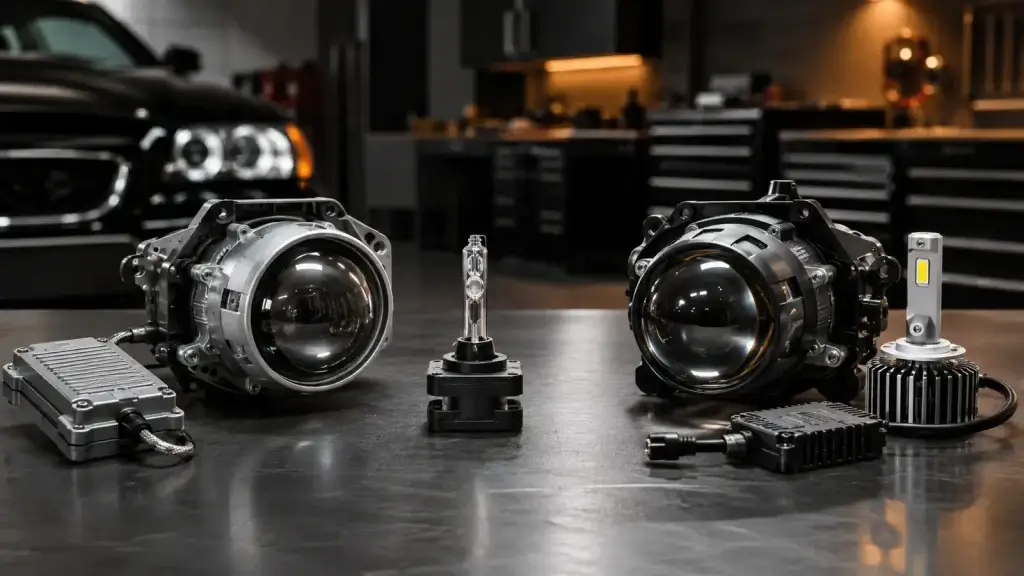
High-intensity discharge and LED headlights create light in very different ways. Both can provide excellent visibility when used with optics designed for them. Neither technology guarantees a good beam when installed into an incompatible housing.
How HID headlights work
An HID capsule creates an electrical arc inside a gas-filled tube. A ballast generates the high starting voltage and then regulates power. The lamp needs a short warm-up period before reaching full output and stable color. HID systems were widely used in projector headlights before high-output LEDs became common.
How LED headlights work
LEDs produce light at semiconductor emitters controlled by a driver. They reach full output immediately and can be arranged in multiple segments. That packaging flexibility supports thin daytime running lights, adaptive beams, and compact styling, but it also makes cooling and module integration important.
Visibility and beam quality
The housing and projector determine beam shape. A well-designed HID projector can outperform a poor LED system. A properly engineered LED assembly can provide a sharp cutoff, broad shoulder light, and instant high-beam response. Color temperature that is extremely blue does not improve vision and can increase perceived glare.
Serviceability and cost
Many HID systems allow the capsule or ballast to be replaced separately. Factory LED systems may integrate the emitter into a sealed assembly, although some have replaceable drivers or modules. Diagnosis matters because a complete headlight assembly can be expensive and may require programming or calibration.
Common HID problems
- Color shifting pink or purple as a capsule ages
- Intermittent ignition caused by a capsule, ballast, wiring, or ground
- Moisture damaging the ballast mounted below the housing
- One side dimmer because capsules were replaced separately
Common LED problems
- Failed driver modules or communication faults
- Thermal dimming or fan failure
- Individual segments or daytime-running-light strips failing
- Condensation and corrosion inside a sealed assembly
Should an HID vehicle be converted to LED?
A plug-in conversion is rarely as simple as matching a connector. The LED emitter must sit at the correct focal point, fit behind the dust cap, cool properly, and work with the vehicle’s electronics. If the original HID optics and components are serviceable, restoring the system often produces a better and more predictable beam than converting it.
The best choice is the system the housing was engineered to use, maintained with quality components and aimed correctly.
Need help with a lighting or electrical problem?
Flickering lamps, warning messages, uneven beams, moisture inside a housing, and repeated bulb failures often need diagnosis before parts are replaced. Vibrance Automotive can inspect the circuit, charging voltage, grounds, modules, housings, and beam aim.
Schedule an inspection or call the shop for availability.