
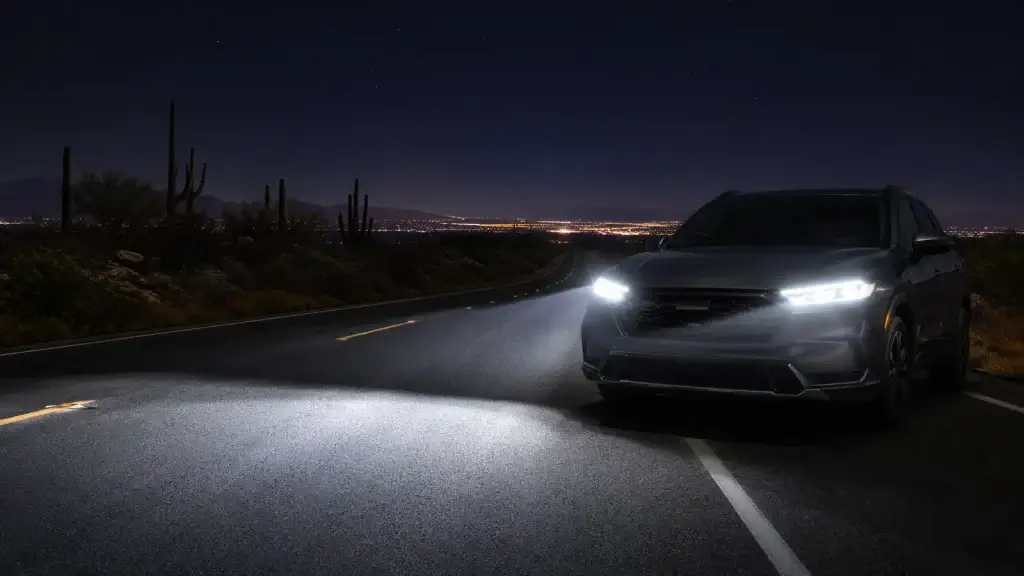
LED lighting has moved from a premium option to standard equipment on many vehicles. It can deliver excellent road visibility, fast response, long service life, and lower current draw. It can also perform poorly when an incompatible retrofit is installed in a housing designed for a different light source.
Where LEDs are used
Vehicles may use LEDs for low and high beams, daytime running lights, turn signals, brake lamps, marker lights, reverse lamps, interior lighting, and auxiliary off-road lighting. Factory systems are engineered as a complete assembly. The emitter, optics, cooling, driver electronics, and vehicle controls are matched to one another.
Brightness is not the same as useful light
Drivers often compare bulbs by lumen claims or color temperature. Road performance depends more on intensity in the correct zones and a controlled cutoff. A source that creates foreground glare can make the road immediately in front of the vehicle look bright while reducing distance vision. Light scattered above the cutoff also affects other drivers and can attract enforcement attention.
Why some LED retrofits flicker
Many vehicles monitor bulb current or use pulse-width modulation. A retrofit may respond to that signal with flickering, warnings, radio interference, or intermittent shutdown. Resistors and so-called error cancellers can create substantial heat and may hide rather than solve a compatibility problem. The better approach is to verify the vehicle circuit, the lamp design, and whether coding or a purpose-built interface is required.
Arizona heat changes the equation
LED emitters dislike excessive junction temperature. A small fan or heat sink that performs adequately in a cool climate can struggle during a Tucson summer, especially inside a sealed dust cap. Heat can reduce output before the lamp visibly fails. Quality equipment uses sufficient thermal mass, reliable drivers, and a cooling layout that fits the housing without defeating its weather sealing.
Aiming matters after any change
Headlight aim can change after collision repair, suspension work, loading changes, housing replacement, or a bulb conversion. The vehicle should sit on level ground with correct tire pressure and normal ride height. Some adaptive systems also require a calibration procedure. A visual guess against a garage door is not a substitute for checking the specified pattern and height.
When replacement is the right answer
A complete factory assembly may be necessary when its sealed LED board, internal wiring, optics, or housing has failed. In other cases, a serviceable driver, connector, bulb, vent, or mounting tab can be repaired without replacing the entire lamp. Diagnosis is particularly valuable when the assembly costs hundreds or thousands of dollars.
For a good result, choose lighting by optical compatibility, cooling, electrical design, warranty, and serviceability. Color and advertised brightness belong much farther down the list.
Need help with a lighting or electrical problem?
Flickering lamps, warning messages, uneven beams, moisture inside a housing, and repeated bulb failures often need diagnosis before parts are replaced. Vibrance Automotive can inspect the circuit, charging voltage, grounds, modules, housings, and beam aim.
Schedule an inspection or call the shop for availability.