
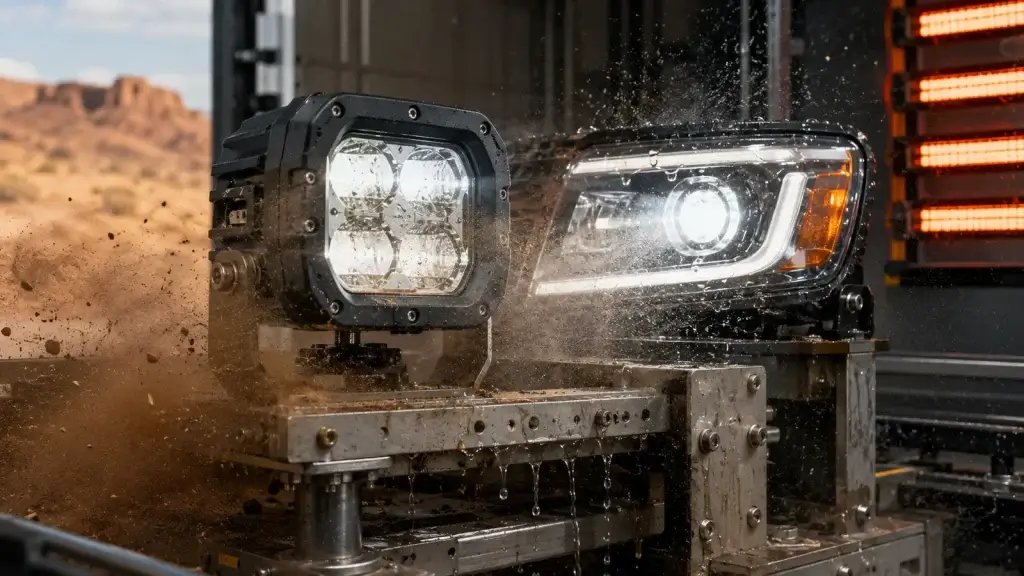
If a headlight or auxiliary lamp fails once, the part itself may be the problem. When the same light fails again, we stop treating it like a simple bulb replacement. Something around that light may be shortening its life.
That is where diagnosis matters. A loose terminal can build heat. A damaged housing can let water in. A broken mounting point can shake a lamp until it fails. An LED conversion can run too hot inside a housing that was never designed for it. Replacing the light again without checking those conditions usually means the customer pays twice for the same unresolved problem.
What the failed part can tell us
We begin with the lamp, socket, connector, housing and mounting points. Each leaves different clues. Melted plastic points us toward excess heat or resistance. Green or white residue usually means moisture has reached an electrical connection. A loose housing or broken tab creates vibration and can also throw the beam out of alignment.
We also look for missing dust caps, pinched seals, standing water and dirt packed around an LED fan or heat sink. Those details matter because installing a new lamp will not correct the condition that damaged the old one.
Why a connector can damage a new bulb
A connector may still deliver power and be in poor condition. Loose terminal tension or corrosion adds resistance. Resistance creates heat under load, sometimes enough to discolor a terminal or soften the socket.
This is why checking an unplugged connector for voltage is not always enough. A circuit can show normal voltage with no load and drop badly once the light is operating. When the evidence points that way, voltage-drop testing helps us find the weak connection instead of guessing at another part.
LED lights still have to manage heat
LEDs use less power than many traditional lamps, but they are not heat-free. The emitter and driver still produce heat, and that heat has to leave through the base, heat sink or fan. Tucson temperatures make a poor installation less forgiving.
Some replacement LEDs fit tightly behind the original dust cap with almost no room for airflow. Others leave the housing open because the cap no longer fits. One arrangement traps heat; the other invites dust and moisture. The right answer depends on the housing and the product, not simply whether the bulb turns on after installation.
Condensation is not always the same as a leak
A light housing is sealed against direct water entry, but many housings still use vents so air pressure and humidity can change. A light haze that clears can be normal. Droplets that remain, water collecting at the bottom or corrosion around the socket are different. Those signs call for checking the housing, cap, seal and vent before another electronic component is installed.
Mounting and wiring matter too
Lighting problems are not limited to factory headlights. Auxiliary lamps need solid brackets, protected wiring, correct wire size, a suitable fuse and, when required, a relay. A lamp mounted on a bracket that flexes over every bump will vibrate, move out of aim and put stress on its wiring.
Wiring should not hang from the connector, rub against metal or sit where water collects. Repairs made in exposed areas also need proper sealing. These are small installation details, but they often decide whether a lighting upgrade lasts.
What we check before recommending another light
- The condition and fit of the bulb, socket and terminals
- Voltage and voltage drop while the circuit is operating
- Ground connections and nearby wiring repairs
- Housing damage, vents, caps, seals and signs of water entry
- Mounting stability and beam aim
- Cooling clearance around LED drivers, fans and heat sinks
- Charging-system concerns when more than one electrical symptom is present
Not every failed light needs extensive diagnosis. Sometimes a bulb has simply reached the end of its life. But repeat failures deserve a closer look. Vibrance Automotive can test the circuit and installation, show you what we find and explain whether the vehicle needs a lamp, a wiring repair, a housing repair or something else.
Request a lighting or electrical inspection or review our automotive electrical repair service.