
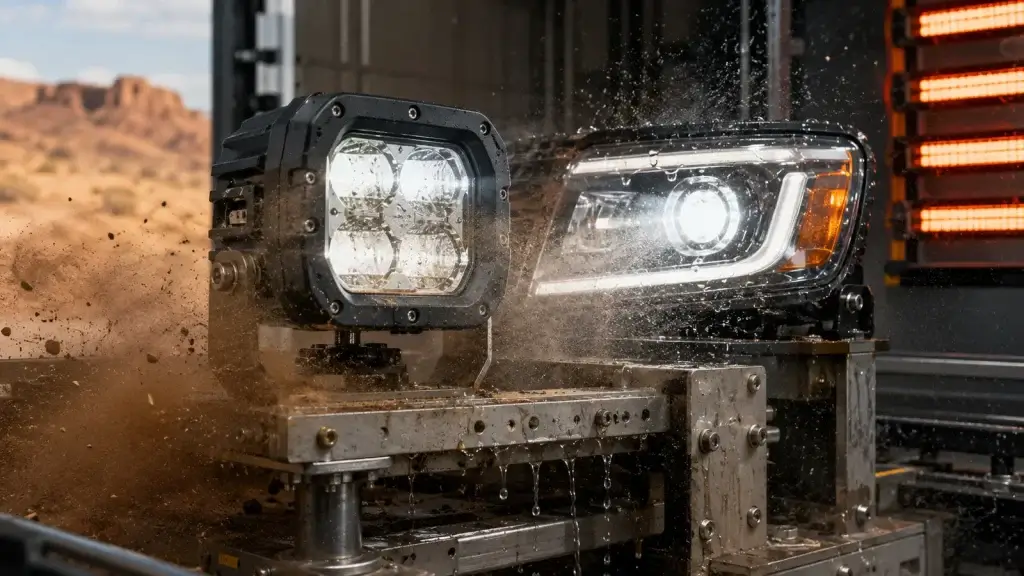
Automotive lamps live in a harsher environment than household lighting. They experience vibration, pothole impacts, pressure changes, dust, water, chemical exposure, charging-system fluctuations, and intense underhood heat. Durability comes from the whole assembly, not simply from using an LED.
Mechanical support and vibration control
A lamp must hold its emitter and optics in precise alignment. Reinforced mounting tabs, secure connectors, strain relief, and well-supported circuit boards prevent vibration from turning into cracked solder joints or a wandering beam pattern. An auxiliary lamp also needs a bracket that will not oscillate on rough roads.
Sealing without trapping moisture
Gaskets, bonded lenses, rear covers, and connector seals keep direct water out. Controlled vents allow pressure and humidity to equalize. A blocked vent can pull moisture through a weak seal as the housing cools. A missing dust cap may seem harmless in dry weather but exposes reflectors, fans, and electronics to fine Arizona dust.
Thermal design
Halogen systems tolerate high bulb temperature but can damage nearby sockets and wiring when the wrong wattage is installed. LED systems need heat moved away from the emitter and driver. Large heat sinks, good thermal interfaces, protected fans, and conservative current levels generally last longer than compact lamps driven at the edge of their capability.
Electrical protection
A healthy vehicle electrical system is not perfectly steady. Starting events, alternator regulation, inductive loads, weak grounds, and jump starts can create stress. Quality drivers include current regulation and protection against reverse polarity, overvoltage, and overheating. Repeated lamp failure should prompt charging-voltage and voltage-drop tests before another replacement is fitted.
Connector and harness quality
Loose terminals create resistance and heat. Green corrosion inside a connector increases voltage drop and can send misleading signals to a control module. Repairs should use correctly sized wire, sealed splices where required, proper terminal tension, and routing that avoids sharp edges and exhaust heat.
Installation details that extend life
- Keep factory caps, vents, and seals intact.
- Mount drivers where they can shed heat and remain dry.
- Secure wiring so it cannot rub or pull on connectors.
- Use relays and fusing appropriate to auxiliary loads.
- Confirm aim after a housing or suspension change.
- Correct water intrusion before installing another module.
A durable lighting repair restores structure, sealing, cooling, wiring, and optical alignment together. Replacing only the failed lamp can leave the condition that caused the failure untouched.
Need help with a lighting or electrical problem?
Flickering lamps, warning messages, uneven beams, moisture inside a housing, and repeated bulb failures often need diagnosis before parts are replaced. Vibrance Automotive can inspect the circuit, charging voltage, grounds, modules, housings, and beam aim.
Schedule an inspection or call the shop for availability.