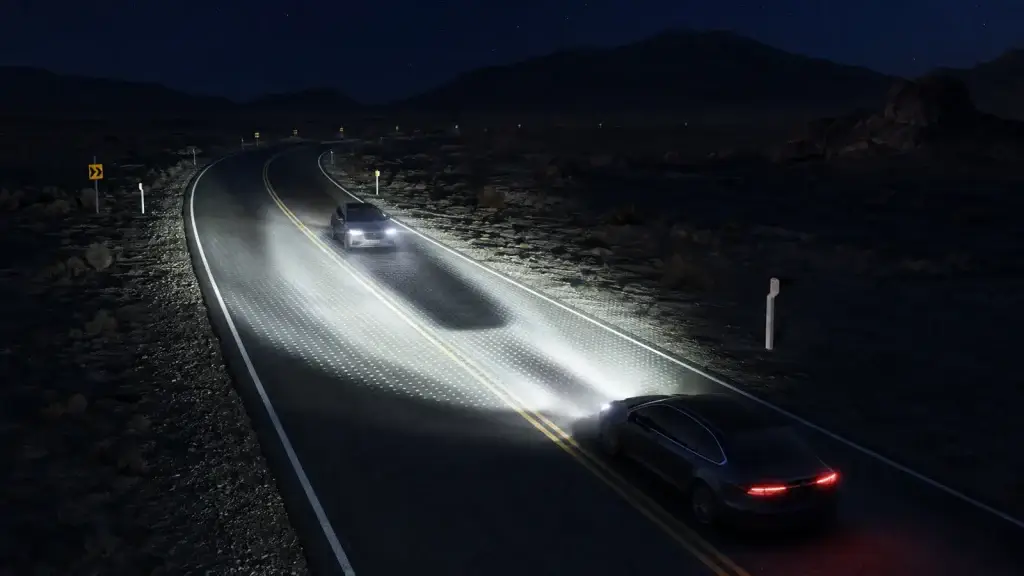
Adaptive headlights do more than turn a lamp on and off. Depending on the vehicle, they can level the beam as the suspension moves, swivel into a curve, vary the pattern with speed, and selectively dim small sections around other road users.
Automatic leveling
Ride-height sensors tell the lighting module how the vehicle is sitting. Motors inside the headlamps adjust vertical aim so cargo, passengers, acceleration, and braking do not send the beam into other drivers’ eyes or down at the pavement. A damaged sensor arm after suspension work can trigger a warning or leave the lamps aimed incorrectly.
Curve-adaptive lighting
Steering angle, yaw, and vehicle-speed information allow some projector modules to rotate into a bend. Other systems add a cornering lamp at low speed. A malfunction can come from the lamp motor, a sensor, calibration, wiring, or module communication.
Matrix high beams
A matrix system divides the beam into controllable segments. A forward camera identifies headlights, taillights, and sometimes pedestrians or reflective signs. The module keeps useful high-beam illumination on open parts of the road while shading the area around detected traffic. The driver gets more distance light without applying full high beam directly to another vehicle.
Why calibration matters
The camera and headlights must agree about where objects are located. Windshield replacement, collision repair, suspension changes, ride-height sensor replacement, or lamp replacement may require static or dynamic calibration. Basic mechanical aim still matters before electronic calibration begins.
Typical warning signs
- Adaptive lighting warning on the instrument panel
- One lamp aimed high, low, or toward the shoulder
- Both lamps perform a startup sweep but one does not return correctly
- High-beam assist stops responding
- Condensation or impact damage in a lamp assembly
- Faults appearing after windshield or suspension work
Diagnosis before replacement
Because these assemblies are expensive, the diagnostic plan should include fault-code scans, live sensor data, power and ground tests, network communication, physical inspection, basic aim, and calibration status. A code naming a headlamp does not automatically prove the whole assembly is defective.
Adaptive lighting is valuable when every part of the system is aligned and communicating. A careful repair restores both visibility and the protection built in for other road users.
Need help with a lighting or electrical problem?
Flickering lamps, warning messages, uneven beams, moisture inside a housing, and repeated bulb failures often need diagnosis before parts are replaced. Vibrance Automotive can inspect the circuit, charging voltage, grounds, modules, housings, and beam aim.
Schedule an inspection or call the shop for availability.