
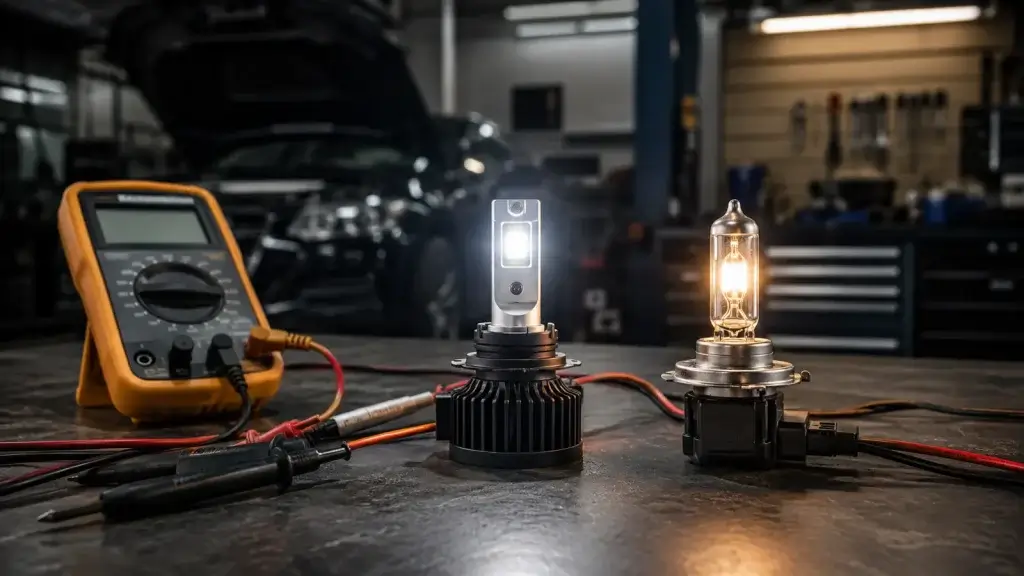
LEDs have become common throughout modern vehicles because they can produce useful light with less electrical power, respond instantly, fit into compact shapes, and last a long time when heat is controlled. Those advantages are real, but they depend on good engineering.
Lower current draw
An efficient LED system can produce comparable light with less current than a traditional incandescent or halogen source. That reduces load on wiring and the charging system and gives designers more flexibility. It does not mean every retrofit is efficient: added resistors, poor drivers, and excessive operating current can waste energy as heat.
Fast response
LED brake lamps illuminate almost immediately. At highway speed, even a small reduction in response time gives a following driver additional distance to react. Instant output also makes LEDs well suited to flashing signals and adaptive high-beam segments.
Compact packaging
Small emitters can be arranged into light pipes, thin daytime-running-light signatures, sequential signals, and multiple beam zones. Designers are no longer limited to the shape of a replaceable round bulb. The tradeoff is that many systems become integrated assemblies rather than simple serviceable sockets.
Long life, under the right conditions
An LED does not have a fragile filament, but its electronics, seals, solder joints, and thermal system still age. Excessive heat is a primary enemy. A lamp that runs too hot may gradually lose output or change color before it fails completely. Arizona temperatures make cooling and component quality especially important.
Better control of the beam
LED arrays can switch or dim individual sections, enabling adaptive patterns that were difficult with a single bulb. Even a fixed LED headlight still depends on precise optics. Putting an LED bulb into a halogen reflector does not automatically recreate the intended focal point or cutoff.
What LEDs do not solve
- A clouded or damaged lens
- A corroded connector or weak ground
- A mis-aimed housing
- Water intrusion
- Charging-system overvoltage
- An incompatible control signal
LED technology is a strong tool, not a shortcut around diagnosis. The best systems combine efficient emitters with appropriate optics, stable drivers, adequate cooling, weather sealing, correct vehicle integration, and precise aim.
Need help with a lighting or electrical problem?
Flickering lamps, warning messages, uneven beams, moisture inside a housing, and repeated bulb failures often need diagnosis before parts are replaced. Vibrance Automotive can inspect the circuit, charging voltage, grounds, modules, housings, and beam aim.
Schedule an inspection or call the shop for availability.